Last year I went to Gamecamp. This year I went again. But this time, I ran my own session, delivering a twelve-minute speech on my ideas about 'quizzical play' to a bunch of people who were kind enough to come and listen. Here is a recording of that talk, as well as my notes, from which I read almost verbatim.
You can listen to the talk on Soundcloud here. You can also listen to the follow-up discussion here. Some parts of it basically summarise or replicates stuff I have already written about Dishonored and Art Game. Below is the full text of my notes, which I have tried to sprinkle through with links to the things I'm talking about. But it might be more fun to listen to the talk; I think so, anyway.
Sunday, 19 May 2013

Sunday, 14 April 2013
What is a mechanic? (my pragmatic view)

This is a little piece about the meaning of the word 'mechanic' which I fired off on Twitter the other day. It's about why talking about mechanics does not need to be rigid or robotic and about the uses and limits of the concept of a 'mechanic'. It's not perfect and probably incomplete but I've been asked to post it on the blog for easier citation and I hope it does a job.
It was prompted by a question from @criticalbrit (now @utterlyhorrid) and a response from @xenobotanist. The original can be found here.
Saturday, 6 April 2013
How does it taste? The sexual politics of how Metal Gear Solid 3 treats Raiden

I like Raiden, okay? I’m a Raiden fan. I have all the merchandise - the action figures, the Skull Suit, the mask for casual and formal wear. So you can imagine my delight when Metal Gear Solid 3 allowed me to dress up as his spitting image – one Ivan Raidenovich Raikov. At first it seems like a bog-standard Metal Gear in-joke, but when it's considered alongside Raikov's relationship with bisexual electo-bastard Colonel Volgin, it suddenly crackles with a sexual charge. So is this a subversive twist on mainstream sexuality? Or just complicated homophobia?
Monday, 1 April 2013
Quizzical play #2: Optimising for Beauty
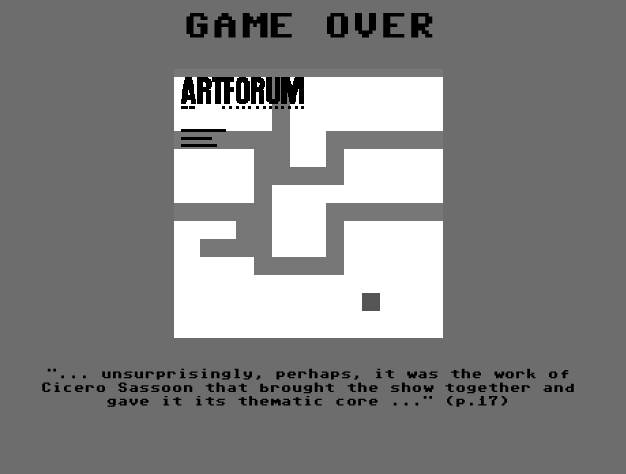 |
| screenshot: Art Game, by Pippin Barr |
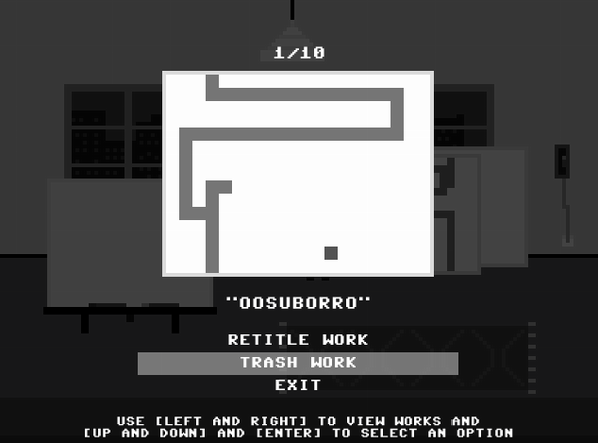
*
They say that inside every critic is a failed artist. It's true; he was delicious. But even I found it hard to resist when Pippin Barr's Art Game offered me a chance at virtual gallery stardom. Playing through it, I felt pride stirring within me, along with the urge to show off my artwork to everyone. So what better way to analyse it than with a picture essay of my very own oeuvre?
Like so many of the games Barr makes, Art Game is set up like a joke. You pick your artist - a painter, a sculptor, or a performing duo - and try to conquer the art world with your works. The punchline is that you do so using the mechanics of classic games like Tetris, Spacewar and Snake. When you lose, your playthough so far becomes an artwork that you can title or simply trash. Soon a curator drops round and assesses your work for display in a gallery, sometimes often rejecting the best and ignorantly lauding the worst. It definitively answers Sophie Houlden's seminal question: can art be games?
Thursday, 21 March 2013
Relax, don't do it: pulling the trigger in Spec Ops: The Line

There is a line that people like us (i.e. games bloggers) have to cross. It is the line which divides people who like Spec Ops: The Line from people who don’t.
On one side, its lauding as a landmark subversion and the subject of Brendan Keogh’s groundbreaking close reading, Killing is Harmless. On the other, the mocking, the eye-rolling; its indictment by J. Shea as the cake-eating adventures of Captain Obvious, by Michael Clarkson as a “gutless and cowardly critique”, and by Darius Kazemi as “a middling shooter fumbling at meaning.”
And me?
Thursday, 7 March 2013
The circles of hell: valence as character and Hitman's obscene moral calculus

I wrote this post AGES ago and promptly forgot about it. I've just unearthed it in the guts of the blog system, and so decided to let it light, regardless of timing. Hope you enjoy it.
*
If you think your family reunions are bad – and believe me, mine are Shakespearian – spare a thought for Agent 47. Every few years he has to push his way to the buffet table through crowds of identical bald men distinguishable only by their barcodes, all disguised as each other and holding syringes behind their backs. Still, 47 is used to feeling anonymous because he was designed to be that way. He is deliberately without personality, a blank human being...as long as you pretend that ‘white’ and ‘male’ are blank attributes.
But what of his enemies?
This week [actually, months ago - ed] I wrote an article over at Gameranx about how the Hitman series handles character and morality. It's a reading of Contracts and Blood Money as "socially conservative treatises on sin and moral frailty" - which, by the by, an explains the origin of Absolution's infamous leather nuns. Here's a bit about BM's rehab clinic mission:
The situation is explicitly psychological: this is a place where people are imprisoned to protect themselves from their own destructive behaviour. The militarised boundaries and guarded checkpoints which make up the game’s bread and butter exist here as much to keep the inmates sober as to keep intruders out. But the system can’t protect your targets if they insist on subverting it. The mobsters seal their own fates with regular visits to secret booze caches, which, through careful observation, you can find and poison. It’s a clever setup because we already think about addiction in this way—both a crime and a sickness, a moral trespass and a fatal weakness. We are exploiting these men, but they also allow it to happen.Read on for a supplementary post.
Tuesday, 5 March 2013
Interview: Jason Rohrer wants you to come home and find your family dead
...and in the game? (Honestly, he said it! It's at the bottom!)
Jason Rohrer was the final developer I interviewed for my New Statesman article. His forthcoming game, The Castle Doctrine, has become embroiled in the political storm over gun rights and self-defence. What fascinated me about it was that it simulated a little world with the specific intention of bringing about numerous armed robberies. After the Trayvon Martin, the Colorado theatre shooting, CeCe McDonald and Sandy Hook, it doesn't get much more political than that.
Jason Rohrer has a long indie pedigree. Five minute mortality simulator Passage did little for me but was played by many; Sleep Is Death allowed players to create stories for each other, while Chain World turns Minecraft into religious mythology. He's 35 years old and has been playing videogames almost his entire life. He became a programmer and studied Computer Science; these days he's able to make a full-time living from his games, and lives with his wife and three kids in Davis, California.
Jason Rohrer was the final developer I interviewed for my New Statesman article. His forthcoming game, The Castle Doctrine, has become embroiled in the political storm over gun rights and self-defence. What fascinated me about it was that it simulated a little world with the specific intention of bringing about numerous armed robberies. After the Trayvon Martin, the Colorado theatre shooting, CeCe McDonald and Sandy Hook, it doesn't get much more political than that.
Jason Rohrer has a long indie pedigree. Five minute mortality simulator Passage did little for me but was played by many; Sleep Is Death allowed players to create stories for each other, while Chain World turns Minecraft into religious mythology. He's 35 years old and has been playing videogames almost his entire life. He became a programmer and studied Computer Science; these days he's able to make a full-time living from his games, and lives with his wife and three kids in Davis, California.
Saturday, 2 March 2013
Pulling off the psychic kiss: A conversation with Richard Hofmeier
For my New Statesman article on political games, and following on from my interview with Merritt Kopas, I spoke to Richard Hofmeier about Cart Life, a "retail simulation for Windows." I had heard a lot about Cart Life and it had been gazing accusingly at me from the top of my 'must play' file for months, so I plunged in as quick as I could.
As it turned out, Hofmeier (@RichardHofmeier on Twitter) was a regular reader, and as interested in hearing my thoughts about the game as I was in hearing his. As such, this interview takes a slightly different form: it's more of a conversation. I abandon the normal journalistic practice of not blabbering on about your own half-formed ideas, and proceed to blabber on about my half-formed ideas. This is the full text of our conversation.
As it turned out, Hofmeier (@RichardHofmeier on Twitter) was a regular reader, and as interested in hearing my thoughts about the game as I was in hearing his. As such, this interview takes a slightly different form: it's more of a conversation. I abandon the normal journalistic practice of not blabbering on about your own half-formed ideas, and proceed to blabber on about my half-formed ideas. This is the full text of our conversation.
Friday, 1 March 2013
"It's a powerful thing to have people tell me how important this game is to them": Interview with Merritt Kopas
It's been too long since I wrote here, and I wanted my first post of 2013 to go off with a polemical bang. But now that we've given the holodeck a bruising, I'd like to post up some of the full interviews from my second piece for the New Statesman: political games.
For that article I wanted to really go beyond platitutes about games wot have politics in them and ask what it means to try and simulate a political situation - to impart an intellectual or emotional message about a system by building and pointedly contextualising a model of that system. One game that did this to interesting effect was Lim, by Merrit Kopas (@m_kopas on Twitter).
For that article I wanted to really go beyond platitutes about games wot have politics in them and ask what it means to try and simulate a political situation - to impart an intellectual or emotional message about a system by building and pointedly contextualising a model of that system. One game that did this to interesting effect was Lim, by Merrit Kopas (@m_kopas on Twitter).
Thursday, 28 February 2013
Fuck the Holodeck
This post was written for Blogs of the Round Table. Read the other entries, when they appear, at Critical Distance.
There is a spectre haunting videogames: the spectre of the holodeck.
Developers, fans and the media are united in doing its work. Janet Murray first summoned the word to game studies, but it has long since escaped her control. In its purest form it is the teleological fantasy that games will one day achieve the status of perfect simulation: computerised experiences of such fidelity that they consume all five senses and immerse the player in a fake reality. But we pay tribute to it whenever we measure our games against it, or imagine that it is the end-goal of the medium; whenever we repeat simple platitudes that immersion is better than distance or the intuitive better than the obtuse.
There is a spectre haunting videogames: the spectre of the holodeck.
Developers, fans and the media are united in doing its work. Janet Murray first summoned the word to game studies, but it has long since escaped her control. In its purest form it is the teleological fantasy that games will one day achieve the status of perfect simulation: computerised experiences of such fidelity that they consume all five senses and immerse the player in a fake reality. But we pay tribute to it whenever we measure our games against it, or imagine that it is the end-goal of the medium; whenever we repeat simple platitudes that immersion is better than distance or the intuitive better than the obtuse.
Saturday, 15 December 2012
When text games go to war: full interviews
 |
| pic: mark muehlhaeusler |
Last week, I got an article up in the New Statesman about text games which challenge mainstream representations of war. This week, I've been posting my full interviews with all the people I talked to - and here's a nice single post which links to them all.
The discussion mostly concerns the capabilities of text versus 3D graphics, representations of war, and indie production values, but also includes some specific stuff about the individual games. Enjoy(?)!(!?!)
"I don't think the AAA FPS can't be introspective. They don't think it's worth their time": Interview with Robert Yang
 |
| pic: radiator |
This is one of a series of interviews I conducted for my article about what text can say about war that AAA games can't. You can read the other interviews by clicking here.
I contacted Robert Yang because I'm a big fan of his blog and in particular his writing about simulation gaps and manshooters (i.e. the difference between a simulation and its subject, and what is implied by where that gap falls). While researching this topic, I found an intriguing blog post about Unmanned which pretty much encapsulated my thesis, and also his blog is almost the same colour as mine, which I applaud.
Thursday, 13 December 2012
War-based IF games as recommended by Emily Short
This is one of a series of interviews I conducted for my article about what text can say about war that AAA games can't. You can read the other interviews by clicking here.
Actually, it isn't so much an interview as a series of recommendations. I contacted Emily Short for this article because I don't know much about interactive fiction, and she, being about the most prominent name in contemporary IF, assuredly does. After booting up the text parser and explaining my idea, Emily gave me a long list of violent or war-related games, mercifully refraining from rising to a terrible joke about getting myself Informed.
Actually, it isn't so much an interview as a series of recommendations. I contacted Emily Short for this article because I don't know much about interactive fiction, and she, being about the most prominent name in contemporary IF, assuredly does. After booting up the text parser and explaining my idea, Emily gave me a long list of violent or war-related games, mercifully refraining from rising to a terrible joke about getting myself Informed.
Tuesday, 11 December 2012
"Our range of actions, their borders and how we move beyond them, is defined by other people": Interview with Aaron Reed
This is one of a series of interviews I conducted for my article about what text can say about war that AAA games can't. You can read the other interviews by clicking here.
I contacted Alan A. Reed for this article because of his game Maybe Make Some Change. Reed is a PhD student in computer science who's researching the intersection between literature and computational media, which was very relevant to my argument. Maybe, with its text interface overlaying murky FPS footage and its ranks of unreliable narrators, perhaps best exemplified my headline.
I contacted Alan A. Reed for this article because of his game Maybe Make Some Change. Reed is a PhD student in computer science who's researching the intersection between literature and computational media, which was very relevant to my argument. Maybe, with its text interface overlaying murky FPS footage and its ranks of unreliable narrators, perhaps best exemplified my headline.
Sunday, 9 December 2012
"There is a symbiotic relationship between technologies of simulation and the military": Interview with Paolo Pedercini
 |
| pic: molleindustria |
This is one of a series of interviews I conducted for my article about what text can say about war that AAA games can't. You can read the other interviews by clicking here.
I contacted Paolo Pedercini about all this because he made Unmanned, which is featured in the article. Unmanned concerns an individual cog in the military machine but uses text to simulate his experience of war in quite a different way to most games. Also, he comprises the staff of La Molleindustria, which makes radical games in at least two senses of the word 'radical'.
After seizing control of a local radio tower, I asked him the following questions.
Saturday, 8 December 2012
"We need empathy simulators, not another game about being a white savior": Interview with Porpentine
 |
| pic: porp |
Yesterday, I got an article up in the New Statesman about text games which challenge mainstream representations of war. I talked to a bunch of IF authors and game developers to write it, but only a small amount of what they said made the wordcount.
So this week I'll be posting my full interviews with all the cool people who gave me quotes. To make things simple, I am going to post them up in alphabetical order of surname - a system which our first guest, Porpentine, has already glitched by having none.
Friday, 7 December 2012
When text games go to war, elsewhere

Somehow, against all odds, I have tricked left-leaning UK magazine The New Statesman to publish an article by me, John Brindle. In it, I examine several text-based war games which challenge the representation of war in mainstream games, and which manage to speak about that subject in ways that AAA can't. You can find it here.
Take 2007’s Rendition, whose title would not exist without the war on terror. Both the first two Modern Warfare games include "interrogation" sequences, once with a beating and once with electrodes. But where they coyly conceal the violence involved, Rendition makes you participate in awful detail. Try to leave the room and you’re told you haven’t done enough to Abdul. “Break Abdul’s toe,” you type, and the game replies: “Which do you mean? his left little toe, his left second toe, his left middle toe, his left fourth toe, his left big toe, his right little toe…” At this point, many players simply quit.
Below are some notes on what I think of the article and what others think of it.
Saturday, 17 November 2012
Why 'Videogames'?

The other day I had a conversation on Twitter with Adam Williamson about why I use the term ‘videogames’.
You, the reader, have probably noticed that every so often someone suggests
that we should use another word. The idea is that the word fails to adequately
reflect a changing medium and needs to be replaced by one that can handle the
job. Academics frequently use ‘digital games’’; Williamson has half-jokingly coined
the term ‘digic’; I once preferred ‘computer game’ because it sounded more
mature. Others have adopted ‘ractive’ from Neal Stephenson’s The Diamond Age, to the clear detriment
of humanity (or at least the English-speaking parts). But I use 'videogames', and here's why.
Wednesday, 31 October 2012
The Political Uses of Fear
 |
| Edited screenshot from Lim, by Merritt Kopas |
This post is in response to Blogs of the Round Table. Trigger warning for street harassment, passing anxiety, rape culture.
Here in
videogameland we relish fear like children relish Halloween.
Actually, we relish Halloween like children relish Halloween.
But our uses of fear are essentially escapist, even hedonistic: we
lust after the adrenaline rush of shocks and frights and cathartic
thrills like the psychologist in Psycho who has a little too much fun delivering the denouement. Games
are very good at fear, too, though when we mention this it's usually
just before we note how bad they are at ~*love*~. But that primal,
animal emotion, that evolutionary hangover that cross-wires nuclear
bombs with teeth and claws, is good for more than rollercoasters. It
has political uses. By harnessing fear we can trap even the most
privileged players in the frightening subjectivity of another. The scariest things are not the ghosts and goblins of seasonal kitsch, but the hidden, suppressed suffering our society produces as if it were a machine specifically constructed for that purpose.
Saturday, 20 October 2012
Quizzical Play #1: How to Not Play Dishonored

This month, everyone except me has been playing Dishonored. I read the blog posts, watch the Let’s Plays, and fantasize about the choices I might make – but right now, £39.99 for a new release is the difference between making rent and borrowing money. At the same time, I can't bear to be left out of the blogging frenzy that's struck up around the game. So how can I write about Dishonored without having played it? Simple: maybe nobody else is playing it either.
Subscribe to:
Posts (Atom)