Showing posts with label art games. Show all posts

Monday, 1 April 2013

Quizzical play #2: Optimising for Beauty

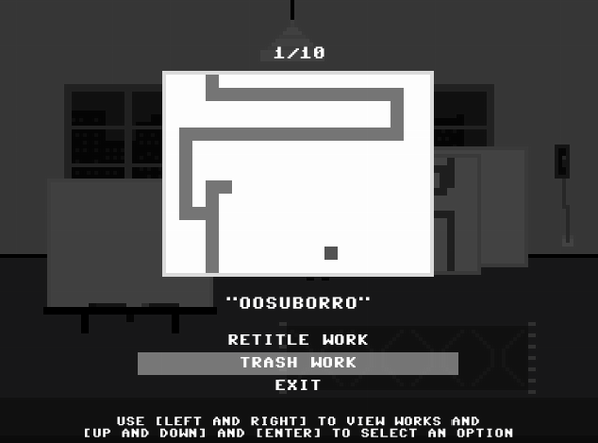
screenshot: Art Game, by Pippin Barr

'Quizzical Play' is a loose grouping of articles which explore what lies beyond the idea of winning and losing in videogames, and how players often subvert these ideas for themselves.

*

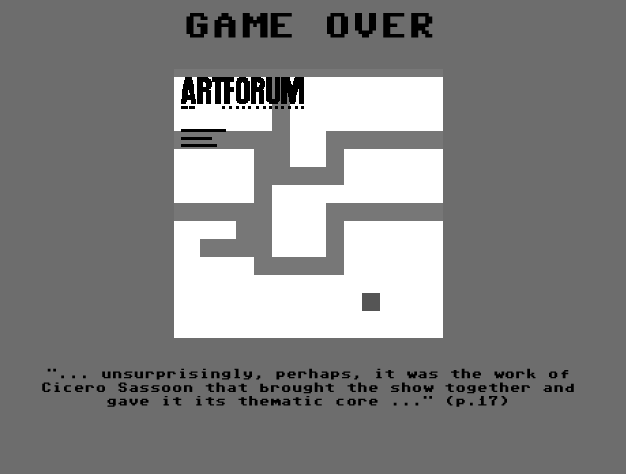
They say that inside every critic is a failed artist. It's true; he was delicious. But even I found it hard to resist when Pippin Barr's Art Game offered me a chance at virtual gallery stardom. Playing through it, I felt pride stirring within me, along with the urge to show off my artwork to everyone.  So what better way to analyse it than with a picture essay of my very own oeuvre?

Like so many of the games Barr makes, Art Game is set up like a joke. You pick your artist - a painter, a sculptor, or a performing duo - and try to conquer the art world with your works. The punchline is that you do so using the mechanics of classic games like Tetris, Spacewar and Snake. When you lose, your playthough so far becomes an artwork that you can title or simply trash. Soon a curator drops round and assesses your work for display in a gallery, sometimes often rejecting the best and ignorantly lauding the worst. It definitively answers Sophie Houlden's seminal question: can art be games?

Saturday, 2 March 2013

Pulling off the psychic kiss: A conversation with Richard Hofmeier

For my New Statesman article on political games, and following on from my interview with Merritt Kopas, I spoke to Richard Hofmeier about Cart Life, a "retail simulation for Windows." I had heard a lot about Cart Life and it had been gazing accusingly at me from the top of my 'must play' file for months, so I plunged in as quick as I could.

As it turned out, Hofmeier (@RichardHofmeier on Twitter) was a regular reader, and as interested in hearing my thoughts about the game as I was in hearing his. As such, this interview takes a slightly different form: it's more of a conversation. I abandon the normal journalistic practice of not blabbering on about your own half-formed ideas, and proceed to blabber on about my half-formed ideas. This is the full text of our conversation.

Friday, 1 March 2013

"It's a powerful thing to have people tell me how important this game is to them": Interview with Merritt Kopas

It's been too long since I wrote here, and I wanted my first post of 2013 to go off with a polemical bang. But now that we've given the holodeck a bruising, I'd like to post up some of the full interviews from my second piece for the New Statesman: political games.

For that article I wanted to really go beyond platitutes about games wot have politics in them and ask what it means to try and simulate a political situation - to impart an intellectual or emotional message about a system by building and pointedly contextualising a model of that system. One game that did this to interesting effect was Lim, by Merrit Kopas (@m_kopas on Twitter).

Saturday, 15 December 2012

When text games go to war: full interviews

pic: mark muehlhaeusler

Last week, I got an article up in the New Statesman about text games which challenge mainstream representations of war. This week, I've been posting my full interviews with all the people I talked to - and here's a nice single post which links to them all.

The discussion mostly concerns the capabilities of text versus 3D graphics, representations of war, and indie production values, but also includes some specific stuff about the individual games. Enjoy(?)!(!?!)

Tuesday, 11 December 2012

"Our range of actions, their borders and how we move beyond them, is defined by other people": Interview with Aaron Reed

This is one of a series of interviews I conducted for my article about what text can say about war that AAA games can't. You can read the other interviews by clicking here.

I contacted Alan A. Reed for this article because of his game Maybe Make Some Change. Reed is a PhD student in computer science who's researching the intersection between literature and computational media, which was very relevant to my argument. Maybe, with its text interface overlaying murky FPS footage and its ranks of unreliable narrators, perhaps best exemplified my headline.

Wednesday, 31 October 2012

The Political Uses of Fear


Edited screenshot from Lim, by Merritt Kopas

This post is in response to Blogs of the Round Table. Trigger warning for street harassment, passing anxiety, rape culture. 

Here in videogameland we relish fear like children relish Halloween. Actually, we relish Halloween like children relish Halloween. But our uses of fear are essentially escapist, even hedonistic: we lust after the adrenaline rush of shocks and frights and cathartic thrills like the psychologist in Psycho who has a little too much fun delivering the denouement. Games are very good at fear, too, though when we mention this it's usually just before we note how bad they are at ~*love*~. But that primal, animal emotion, that evolutionary hangover that cross-wires nuclear bombs with teeth and claws, is good for more than rollercoasters. It has political uses. By harnessing fear we can trap even the most privileged players in the frightening subjectivity of another. The scariest things are not the ghosts and goblins of seasonal kitsch, but the hidden, suppressed suffering our society produces as if it were a machine specifically constructed for that purpose.


Sunday, 15 July 2012

Good Question: The Games of Pippin Barr

Art: Pippin Barr (with permission)

What do you call an unwinnable game that players can compete to lose the most often? Or a game about our experience of art that simultaneously denies us the chance to experience it and simulates it perfectly? Or a physics platformer in which having complete control of all physics variables – and seemingly utmost power over the game – still leaves you with quite conventional puzzles to solve? You might call them a bit of a joke. You might call them experiments in paradox. You might call them horse shit (which is your prerogative, I suppose). But you might just call them the games of Pippin Barr.

Wednesday, 28 September 2011

Notes on 'The Marriage'

'A Garden Party At Which The Husband Is Uncomfortable'


There’s plenty to say about Rod Humble’s The Marriage – a game I briefly mentioned in last week’s article – that would have suffered from being stuffed into it. This is a tangential analysis.

Thursday, 22 September 2011

Consider the Unicorn

The late-night drunk has a new song in his repertoire. I heard it not too long ago, when I was still a student, returning home from a club at 2am. Three others, crossing the road ahead of me, began without warning to belt out Erasure’s camptastic sugar-bomb: ALWAYS! I WANT TO BE WITH YOU! MAKE BELIEVE WITH YOU! We all know who to blame. It’s that bastard unicorn.

How did a tiny two-button flash game end up on the streets of Brighton? Some time ago Rod Humble – EA’s Captain of Sims by day and spare-time indie meddler by night – wrote about the ancient Egyptian game of Senet, whose intricate boards and pieces have been excavated and studied but whose animating principles are lost forever. Yet any future archaeologists who dig up Robot Unicorn Attack will have the opposite problem: they’ll have the code, but they still won’t understand why anyone gave a shit. Although you can peel back its skin and sweep away the sparkles to focus on the underlying rules, trying to pin down its appeal to any mechanical facet seems fruitless.