Last year I went to Gamecamp. This year I went again. But this time, I ran my own session, delivering a twelve-minute speech on my ideas about 'quizzical play' to a bunch of people who were kind enough to come and listen. Here is a recording of that talk, as well as my notes, from which I read almost verbatim.
You can listen to the talk on Soundcloud here. You can also listen to the follow-up discussion here. Some parts of it basically summarise or replicates stuff I have already written about Dishonored and Art Game. Below is the full text of my notes, which I have tried to sprinkle through with links to the things I'm talking about. But it might be more fun to listen to the talk; I think so, anyway.
Showing posts with label aesthetics. Show all posts
Showing posts with label aesthetics. Show all posts
Sunday, 19 May 2013

Sunday, 14 April 2013
What is a mechanic? (my pragmatic view)

This is a little piece about the meaning of the word 'mechanic' which I fired off on Twitter the other day. It's about why talking about mechanics does not need to be rigid or robotic and about the uses and limits of the concept of a 'mechanic'. It's not perfect and probably incomplete but I've been asked to post it on the blog for easier citation and I hope it does a job.
It was prompted by a question from @criticalbrit (now @utterlyhorrid) and a response from @xenobotanist. The original can be found here.
Monday, 1 April 2013
Quizzical play #2: Optimising for Beauty
 |
| screenshot: Art Game, by Pippin Barr |
*
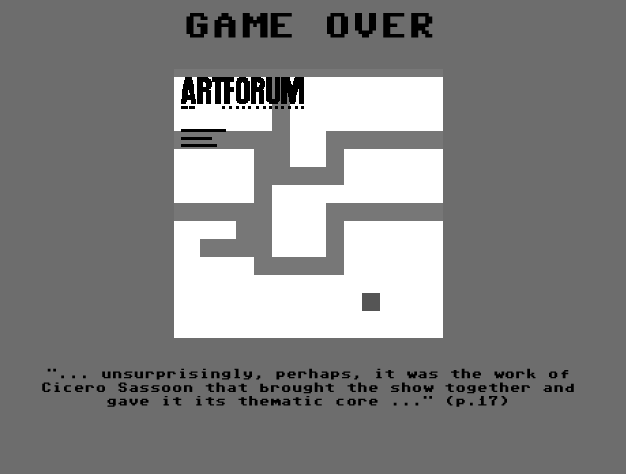
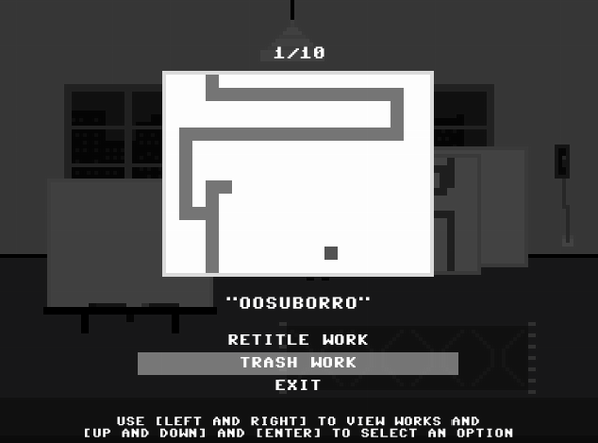
They say that inside every critic is a failed artist. It's true; he was delicious. But even I found it hard to resist when Pippin Barr's Art Game offered me a chance at virtual gallery stardom. Playing through it, I felt pride stirring within me, along with the urge to show off my artwork to everyone. So what better way to analyse it than with a picture essay of my very own oeuvre?
Like so many of the games Barr makes, Art Game is set up like a joke. You pick your artist - a painter, a sculptor, or a performing duo - and try to conquer the art world with your works. The punchline is that you do so using the mechanics of classic games like Tetris, Spacewar and Snake. When you lose, your playthough so far becomes an artwork that you can title or simply trash. Soon a curator drops round and assesses your work for display in a gallery, sometimes often rejecting the best and ignorantly lauding the worst. It definitively answers Sophie Houlden's seminal question: can art be games?
Thursday, 21 March 2013
Relax, don't do it: pulling the trigger in Spec Ops: The Line

There is a line that people like us (i.e. games bloggers) have to cross. It is the line which divides people who like Spec Ops: The Line from people who don’t.
On one side, its lauding as a landmark subversion and the subject of Brendan Keogh’s groundbreaking close reading, Killing is Harmless. On the other, the mocking, the eye-rolling; its indictment by J. Shea as the cake-eating adventures of Captain Obvious, by Michael Clarkson as a “gutless and cowardly critique”, and by Darius Kazemi as “a middling shooter fumbling at meaning.”
And me?
Friday, 1 March 2013
"It's a powerful thing to have people tell me how important this game is to them": Interview with Merritt Kopas
It's been too long since I wrote here, and I wanted my first post of 2013 to go off with a polemical bang. But now that we've given the holodeck a bruising, I'd like to post up some of the full interviews from my second piece for the New Statesman: political games.
For that article I wanted to really go beyond platitutes about games wot have politics in them and ask what it means to try and simulate a political situation - to impart an intellectual or emotional message about a system by building and pointedly contextualising a model of that system. One game that did this to interesting effect was Lim, by Merrit Kopas (@m_kopas on Twitter).
Saturday, 15 December 2012
When text games go to war: full interviews
 |
| pic: mark muehlhaeusler |
Last week, I got an article up in the New Statesman about text games which challenge mainstream representations of war. This week, I've been posting my full interviews with all the people I talked to - and here's a nice single post which links to them all.
The discussion mostly concerns the capabilities of text versus 3D graphics, representations of war, and indie production values, but also includes some specific stuff about the individual games. Enjoy(?)!(!?!)
"I don't think the AAA FPS can't be introspective. They don't think it's worth their time": Interview with Robert Yang
 |
| pic: radiator |
This is one of a series of interviews I conducted for my article about what text can say about war that AAA games can't. You can read the other interviews by clicking here.
I contacted Robert Yang because I'm a big fan of his blog and in particular his writing about simulation gaps and manshooters (i.e. the difference between a simulation and its subject, and what is implied by where that gap falls). While researching this topic, I found an intriguing blog post about Unmanned which pretty much encapsulated my thesis, and also his blog is almost the same colour as mine, which I applaud.
Thursday, 13 December 2012
War-based IF games as recommended by Emily Short
This is one of a series of interviews I conducted for my article about what text can say about war that AAA games can't. You can read the other interviews by clicking here.
Actually, it isn't so much an interview as a series of recommendations. I contacted Emily Short for this article because I don't know much about interactive fiction, and she, being about the most prominent name in contemporary IF, assuredly does. After booting up the text parser and explaining my idea, Emily gave me a long list of violent or war-related games, mercifully refraining from rising to a terrible joke about getting myself Informed.
Tuesday, 11 December 2012
"Our range of actions, their borders and how we move beyond them, is defined by other people": Interview with Aaron Reed
This is one of a series of interviews I conducted for my article about what text can say about war that AAA games can't. You can read the other interviews by clicking here.
I contacted Alan A. Reed for this article because of his game Maybe Make Some Change. Reed is a PhD student in computer science who's researching the intersection between literature and computational media, which was very relevant to my argument. Maybe, with its text interface overlaying murky FPS footage and its ranks of unreliable narrators, perhaps best exemplified my headline.
Sunday, 9 December 2012
"There is a symbiotic relationship between technologies of simulation and the military": Interview with Paolo Pedercini
 |
| pic: molleindustria |
This is one of a series of interviews I conducted for my article about what text can say about war that AAA games can't. You can read the other interviews by clicking here.
I contacted Paolo Pedercini about all this because he made Unmanned, which is featured in the article. Unmanned concerns an individual cog in the military machine but uses text to simulate his experience of war in quite a different way to most games. Also, he comprises the staff of La Molleindustria, which makes radical games in at least two senses of the word 'radical'.
After seizing control of a local radio tower, I asked him the following questions.
Saturday, 8 December 2012
"We need empathy simulators, not another game about being a white savior": Interview with Porpentine
 |
| pic: porp |
Yesterday, I got an article up in the New Statesman about text games which challenge mainstream representations of war. I talked to a bunch of IF authors and game developers to write it, but only a small amount of what they said made the wordcount.
So this week I'll be posting my full interviews with all the cool people who gave me quotes. To make things simple, I am going to post them up in alphabetical order of surname - a system which our first guest, Porpentine, has already glitched by having none.
Saturday, 17 November 2012
Why 'Videogames'?

The other day I had a conversation on Twitter with Adam Williamson about why I use the term ‘videogames’.
You, the reader, have probably noticed that every so often someone suggests
that we should use another word. The idea is that the word fails to adequately
reflect a changing medium and needs to be replaced by one that can handle the
job. Academics frequently use ‘digital games’’; Williamson has half-jokingly coined
the term ‘digic’; I once preferred ‘computer game’ because it sounded more
mature. Others have adopted ‘ractive’ from Neal Stephenson’s The Diamond Age, to the clear detriment
of humanity (or at least the English-speaking parts). But I use 'videogames', and here's why.
Saturday, 21 April 2012
Reality is Beastly: when videogames meet thirteenth century heresy

In a parallel universe, I start this article by declaring how sodding tired I am of games about the 13th-century Catharite heresy and its persecution by the Catholic Church. Sadly, in this world, there is only L’Abbaye Des Morts. Dealing with a dark and obscure annex of European history, creator Locomalito opts for the dark and obscure conventions of classic insta-death platformers like Manic Miner. But because of how it uses these conventions, it is – delightfully – not just a game about the Cathars, but a Catharite game.
Saturday, 14 January 2012
Teaching the Camera to Lie: Amnesia and the First-Person Other
Holmes breathes heavily, his face pressed against the wall. He has been running, running for hours, and now he has resorted to screwing up his eyes and trying not to look at the thing that is chasing him. But the temptation is too great. He slowly peers, behind him – and cries out, for though he never made a sound, Watson is there. Watching.
This chilling effect, while hopefully unintentional, tells us much about what First Person games can do. Watson’s creepy teleportation is possible precisely because so much of the environment is obscured behind the edge of the screen.
In ‘First Person Problems’ we argued that although early developers were attracted to first person because of the limitations it enforced, the rise of the shooter has over-prioritised the accuracy and power it allows. I advocated stepping back and re-examining the possibilities its evolution has left behind. Amnesia: The Dark Descent is a game whose developers did just that – illuminating in the constellation of first person’s pros and cons a rarely recognised capacity for subjectivity, and achieving a literary trope not often found in videogames: the unreliable narrator.
Wednesday, 28 September 2011
Notes on 'The Marriage'
 |
| 'A Garden Party At Which The Husband Is Uncomfortable' |
There’s plenty to say about Rod Humble’s The Marriage – a game I briefly mentioned in last week’s article – that would have suffered from being stuffed into it. This is a tangential analysis.
Thursday, 22 September 2011
Consider the Unicorn
The late-night drunk has a new song in his repertoire. I heard it not too long ago, when I was still a student, returning home from a club at 2am. Three others, crossing the road ahead of me, began without warning to belt out Erasure’s camptastic sugar-bomb: ALWAYS! I WANT TO BE WITH YOU! MAKE BELIEVE WITH YOU! We all know who to blame. It’s that bastard unicorn.
How did a tiny two-button flash game end up on the streets of Brighton? Some time ago Rod Humble – EA’s Captain of Sims by day and spare-time indie meddler by night – wrote about the ancient Egyptian game of Senet, whose intricate boards and pieces have been excavated and studied but whose animating principles are lost forever. Yet any future archaeologists who dig up Robot Unicorn Attack will have the opposite problem: they’ll have the code, but they still won’t understand why anyone gave a shit. Although you can peel back its skin and sweep away the sparkles to focus on the underlying rules, trying to pin down its appeal to any mechanical facet seems fruitless.
Subscribe to:
Posts (Atom)